or
On Flexible Bodies and Overwhelming Ideas
by Viktor Čech and Zuzana Žabková
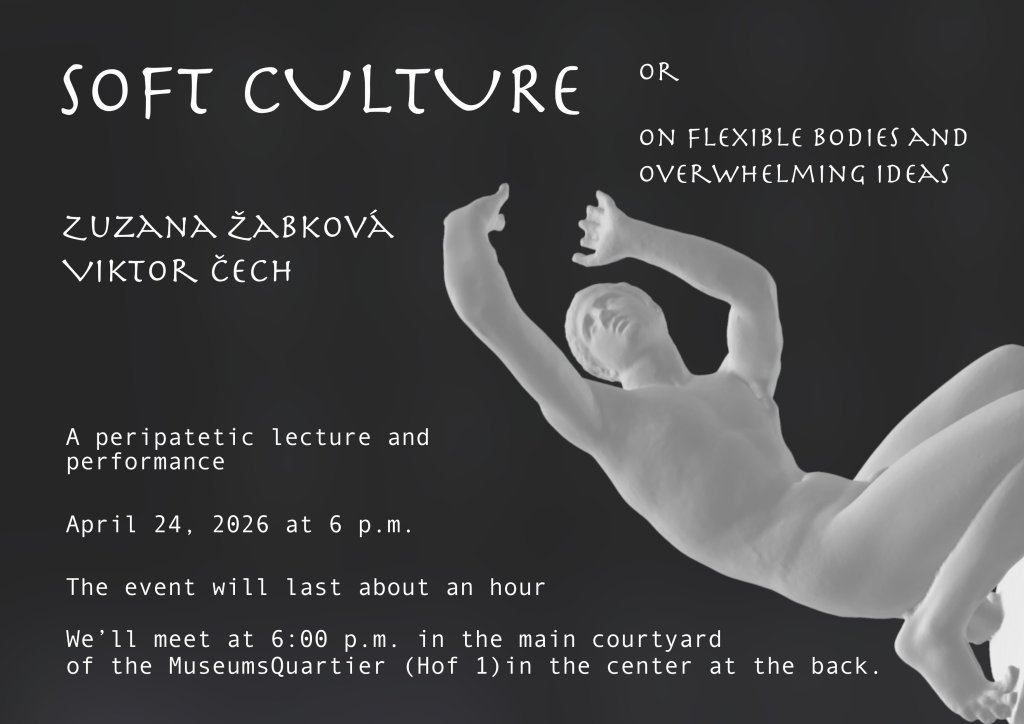
Friday, April 24, 2026, 6:00 p.m. – 7:40 p.m., Vienna
Start in the main courtyard of Vienna’s MuseumsQuartier (Hof 1), the first stop is near the Naturhistorisches Museum, then in the Volksgarten next to the Theseus Temple, the third at Helden platz, and the last on the lawn in the Burggarten.
Introduction
Welcome to our peripatetic lecture, combined with performative moments. We will focus on several places and the situations and people associated with them, mainly from the field of interwar avant-garde dance and contemporary sculpture. The questions we will ask and the ghosts we will evoke, however, have a much broader scope and concern not only the local interwar culture, but above all the clashes of individuals and their bodies with ideologies, historical constructs and the consequences that flow from them to the present day.
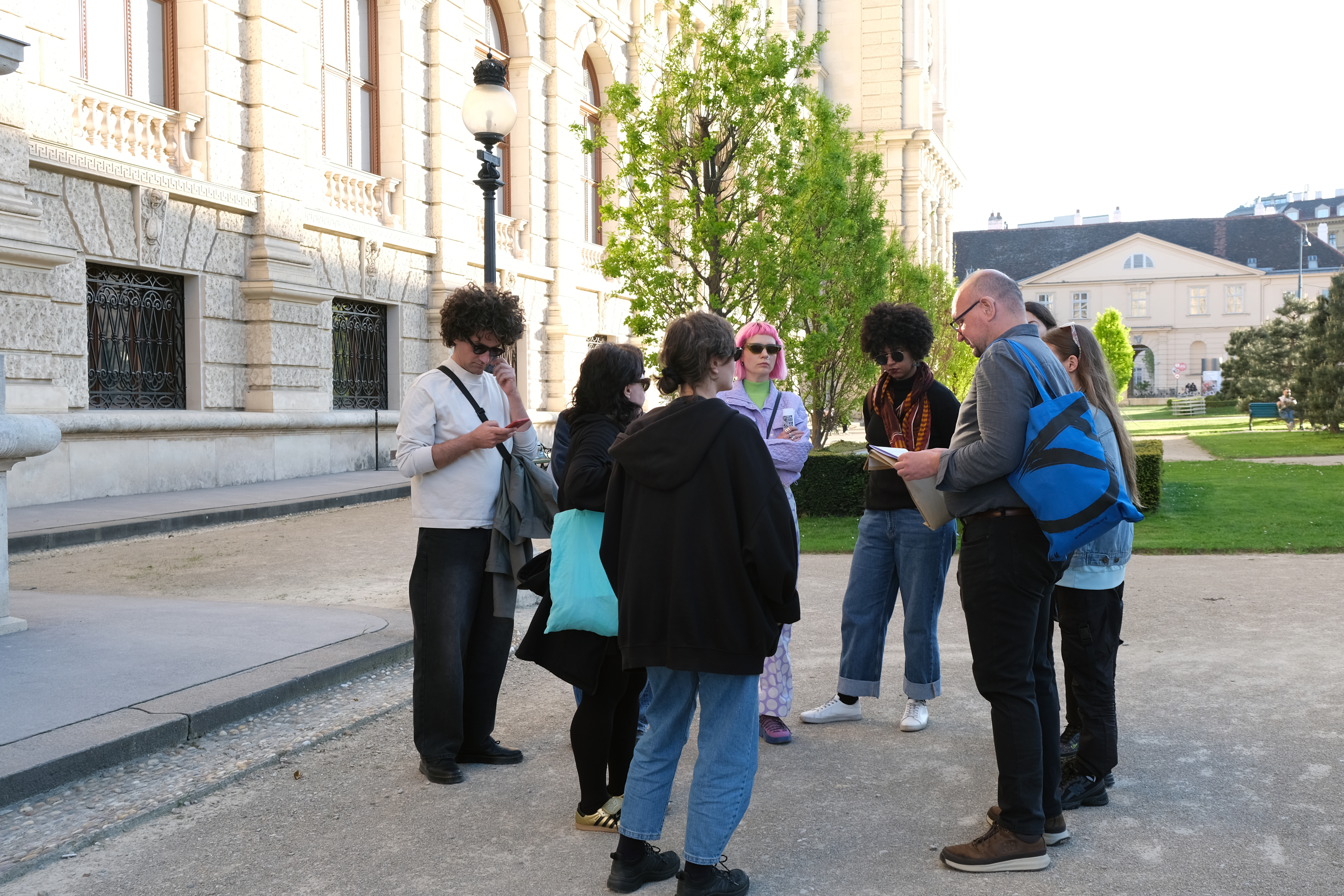
Our walk will take about one hour and will be about one and a half kilometers long. We will leave the MQ area through the side north entrance and walk along the back of the Naturhistorisches museum, across the Ring to the Volksgarten near the Theseustempel. Here the first performative Act will take place. Then we will pass Heldenplatz – where we will stop at the monument to Archduke Karl for Act Two. The last third act will take place in the adjacent Burggarten, where we can then enjoy a small snack and engage in discussion.
Can places and spaces serve as repositories not only of material memory but also of embodied historical memory? Is it possible to reconstruct the story of a given city, country, or culture from these trajectories and intersections of past bodies—their movements, choreographies of clusters of people or solitary individuals? Can this help us find answers to historical traumas of modernism that still resonate in Austrian and Central European society? Such as the legacy of fascism, nazism, and intolerance, as well as unfulfilled or warped dreams and utopias, followed by decades of historical amnesia.
This peripatetic lecture and performance will attempt to answer these questions. It will draw on two fields where the aesthetics and politics of corporeality and movement serve as a fundamental starting point: choreography and monumental sculpture. Specifically, it will be based on encounters with a few examples of interwar avant-garde dance (Gertrud Bodenwieser, Zdenka Podhajská, Hilde Holger and others) and Austrian sculpture of the time (Josef Müllner). Together, the theorist and the artist will guide you on a brief journey through a series of encounters with past bodies, where history intersects with contemporary cultural and political issues.
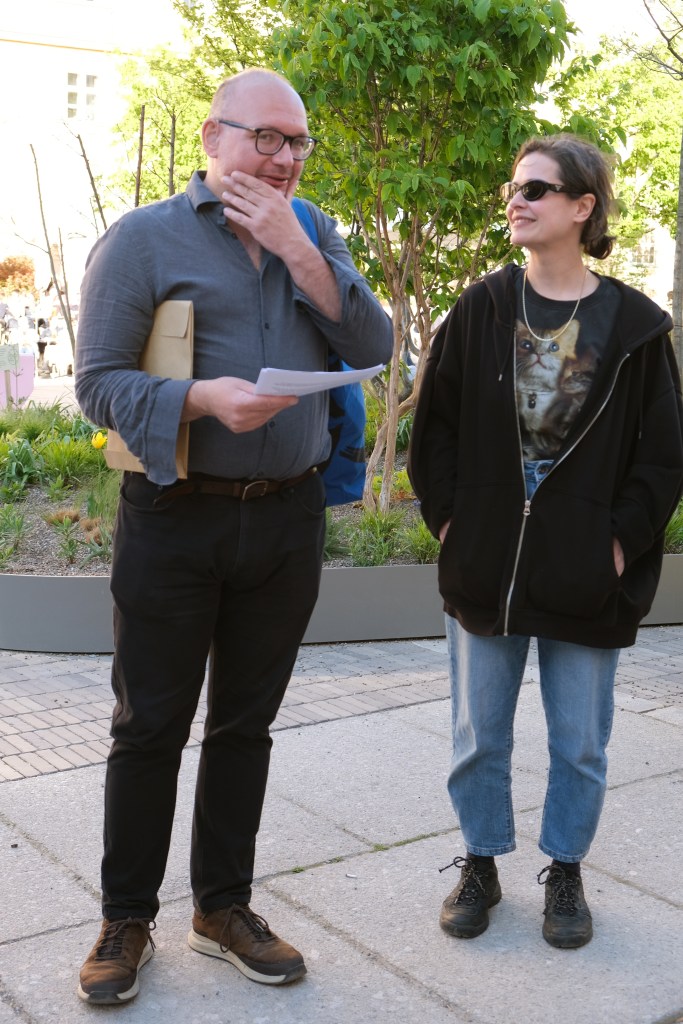
The First stop near the Naturhistorisches Museum
We will focus on bodies. Bodies that may be dead today, but are still present in the memory of these places and spaces. Bodies that were very different – some were actually dead at the time of their creation, others were threatened with extinction in the period immediately following the one to which our locally historical probes return. Some of these bodies were hard and masculine, others supple and feminine.
However, we will not focus on their systematic anthropological classification, as Josef Wastl, the head of the Anthropology Department there in this building next to us – the Naturhistorisches Museum, a proponent of racial theory and active Nazi, attempted to do. For his positivist approach, bodies were just a statistical column with various embedded values. All that was needed was to find enough research material – Jews, prisoners of war or inhabitants of remote villages. The resulting data, in turn, only proved the absence of real individuality. All that remained was a statistical averaging of the given group.
For us, the human bodies will be the coordinates of the encounters between cultural upheavals, political struggles and individual identity. All this in the period between the two world wars, which in our action becomes a kind of distant, yet frighteningly close, anachronistic parallel to our dramatic present.
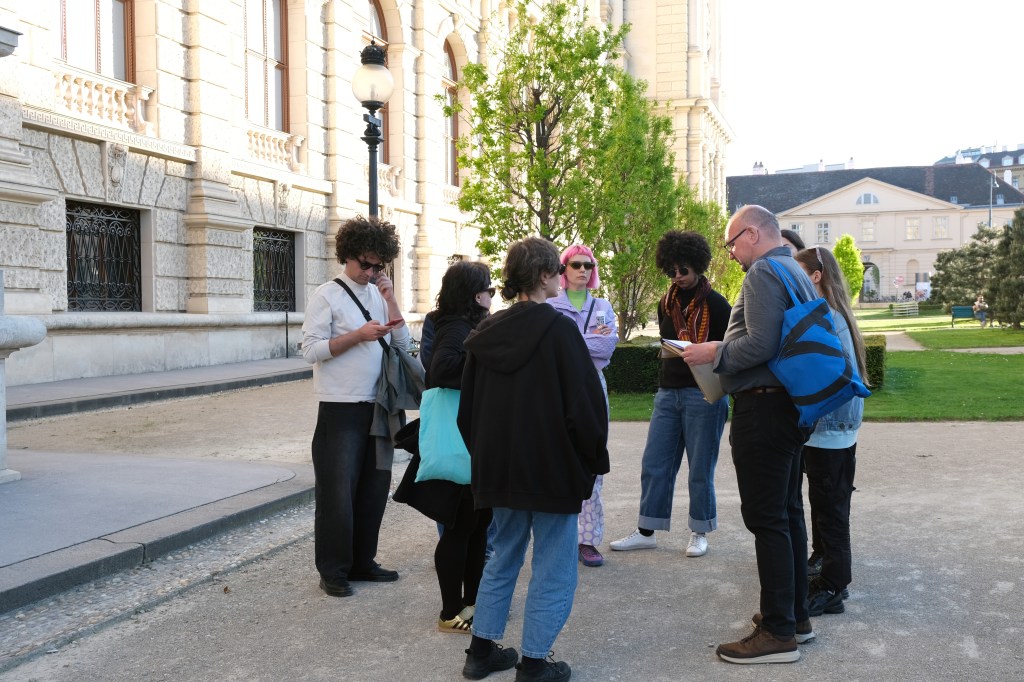
The Second stop at the Volksgarten
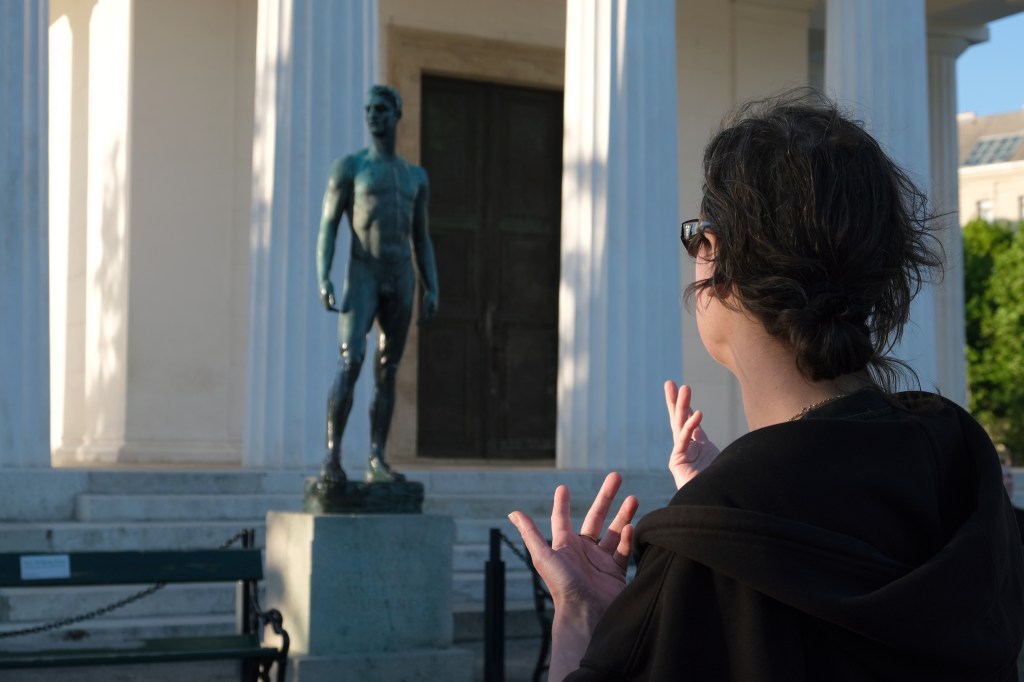
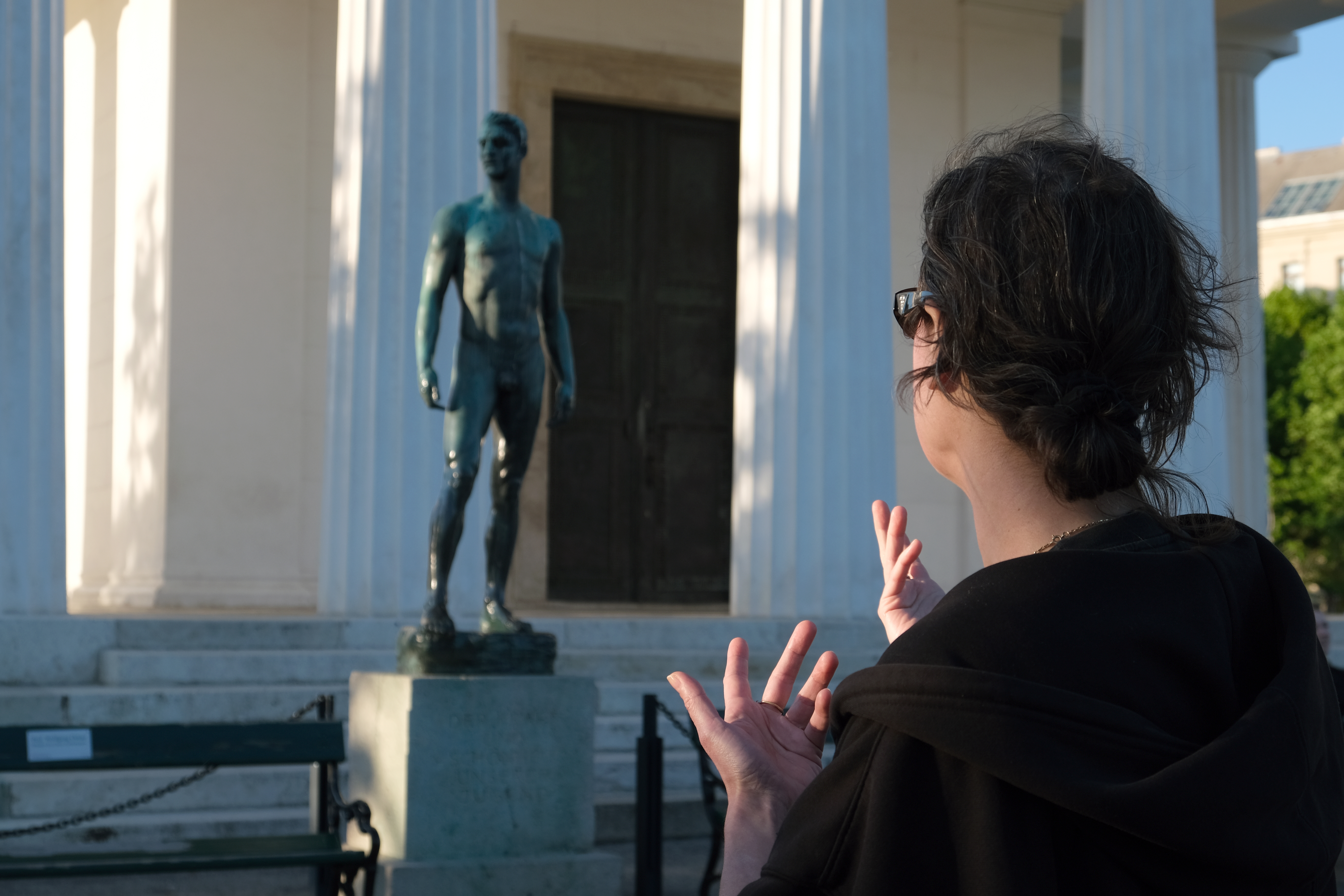
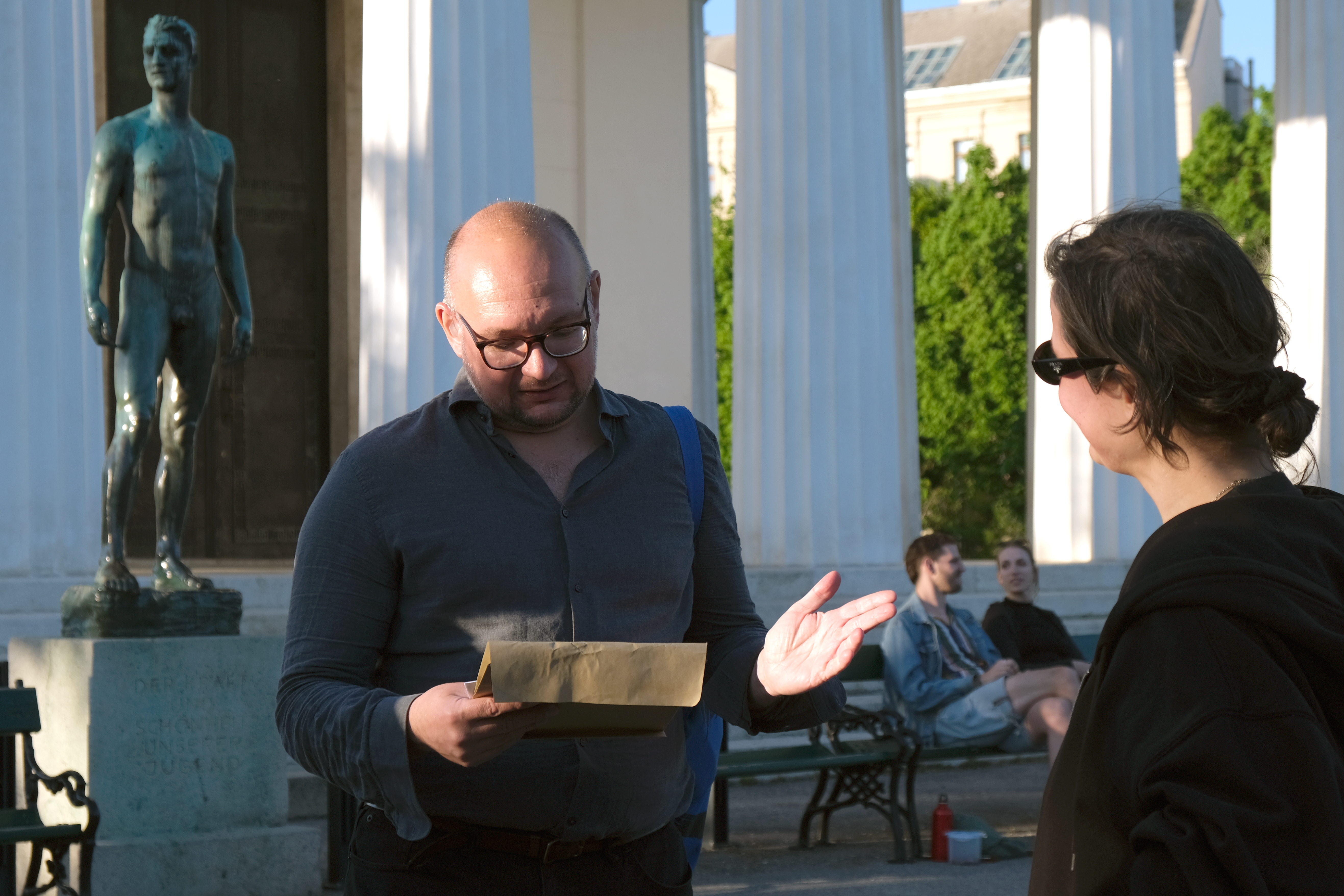
The statue of the Victor (or Young Athlete) by Josef Müllner from 1921. Josef Müllner was a sculptor, teacher, rector and leading representative of the Vienna Academy of Fine Arts. Politically active. Member of the NSDAP and a convinced Nazi. Teacher of a number of sculptors, some of whom (such as Josef Thorak) were also favorite authors of the leaders of the Third Reich. The sculptor is known for a number of cases in recent years – such as the recontextualization of his Siegfried head in the courtyard of the University of Vienna and the ongoing discussion about the now also “recontextualized” monument to the populist and anti-Semite Karl Lueger.
An athlete standing in a light contrapposto, but with his muscles still ready for action. His head turned to the right closely observes his surroundings. He is accompanied by the inscription on the plinth: “The Strength and Beauty of Our Youth”. But the young athlete is also the embodiment of alertness and vigilance. He directly personifies the slogan that so often appears in various variations in various national and otherwise political sports organizations: Always be prepared! Light flows down the bronze surface of this elegant, slender body like sweat or oil that bodybuilders use to lubricate themselves. Such a traditional figure, yet connected with a clear message of the time, has been vigilantly guarding the Volksgarten since its erection in 1922. The sculptor who created it did not become a real Nazi until many years later. Nevertheless, in this seemingly uncontroversial work of his, a number of signs associated with later official fascist and Nazi sculpture already appear. The form is almost chillingly smooth. A hard and determined facial expression and gaze. The overall tension of the figure’s muscles, which lacks the relaxed element so typical of classical antique contrapposto.
This statue celebrates youth and prowess, but at the same time shows discipline and submission to the dream of the metamorphosis of individuals according to a sterilely perfect form. Ideal perfection is always the antithesis of life and its individuality, which is born precisely from the imperfections added up in time and space. Wastl’s racial anthropological collection of human data, casts, photographs, and even hair in the Naturhistorisches Museum had a similarly unnatural effect.
The physically perfect heroes of such statues, but also of Leni Riefenstahl’s shots, are mere images, a dissected representation of a frozen state – a lifeless illusion. In other words, just a dead form. This Ideal was often presented in its monuments by the undemocratic political regimes of that time, although this statue was created during the First Austrian Republic. But where such thinking about human bodies led can be seen later in the monuments of Nazism and Stalinism standing opposite each other at the Paris World Exhibition in 1937. Of which the Nazi figures were the work of Josef Thorak, Müllner’s student.
Bodies cast, bodies constructed. Bodies that are transformed into a perfectly uniform image through discipline, sport, and repeated ideals. Individuals who cease to be individuals and are alienated from themselves. An ideal young strong athlete. The ideal worker, conscript, and soldier. Material. Fascist desired to elevate this self-alienation into an absolute value. Imperfection was taboo. In a world where the First World War shattered the last remnants of the image of the integral man and left behind a panopticon of cubist monsters and expressionist madmen, the neoclassical aesthetic reaction prefers the nostalgic fiction of the intact body. The interwar radical right and left often perceived the formation of a New man as a kind of necromancy. The both neoclassicists and avantgarde treated the body as it were already dead. First as a kind of statue. As this Müllner’s work suggests. Second as a kind of mechanism. As can be seen in the approach of Futurists and Constructivists.
Although the Viennese avant-garde dancer and choreographer of Jewish origin, Gertrud Bodenwieser, was close to the left-wing political environment of the Red Vienna, in whose social programs she directly participated by organizing collective exercises for workers and members of social communities, she clearly did not share the belief of many communists and left-wing intellectuals in the technological and scientific transformation of the “New Man”. This is evident primarily in the warning of what would come of such a transformation in her famous choreography Dämon Maschine from 1924. This choreography is actually a kind of prototype for a much more narrative presentation of a similar theme in Fritz Lang’s film Metropolis, which was made three years later.
ZŽ:
I want to speak about the choreography of Demonic Machine by Gertrud Bodenwieser, and about a single gesture that holds her story and history.
Watching the piece from the beginning, you notice a major shift in cadence somewhere in the first third. It opens with dancers moving in long, curvy phrases — almost classical in quality, the hands tracing soft arcs over harmonic music. Then, without warning, the music breaks into staccato and the movement transforms completely: rectangular, mechanical, edgy. A somehow grotesque embodiment of industrialisation imprinted into the bodies of the dancers.
But what interests me most is the moment of transition itself. From those fluid, harmonic hands, the dancers swiftly formalise into a pyramidal composition — and all of them begin to hold trembling, shaking fists. Different positions, different heights, but that trembling freezes time. And from that frozen moment, an entirely different body emerges: futuristic, mechanical, constructivist.
What makes this gesture so charged is that the shaking fist holds two of the central paradoxes of modern dance simultaneously. On one side, the futurist mechanical body — the Bauhaus aesthetic, Oskar Schlemmer, Hilde Holger and others. On the other, the Ausdruckstanz quality — the expressionistic, lyrical, emotional gesture. The trembling fist contains both. It doesn’t resolve the tension. It inhabits it.
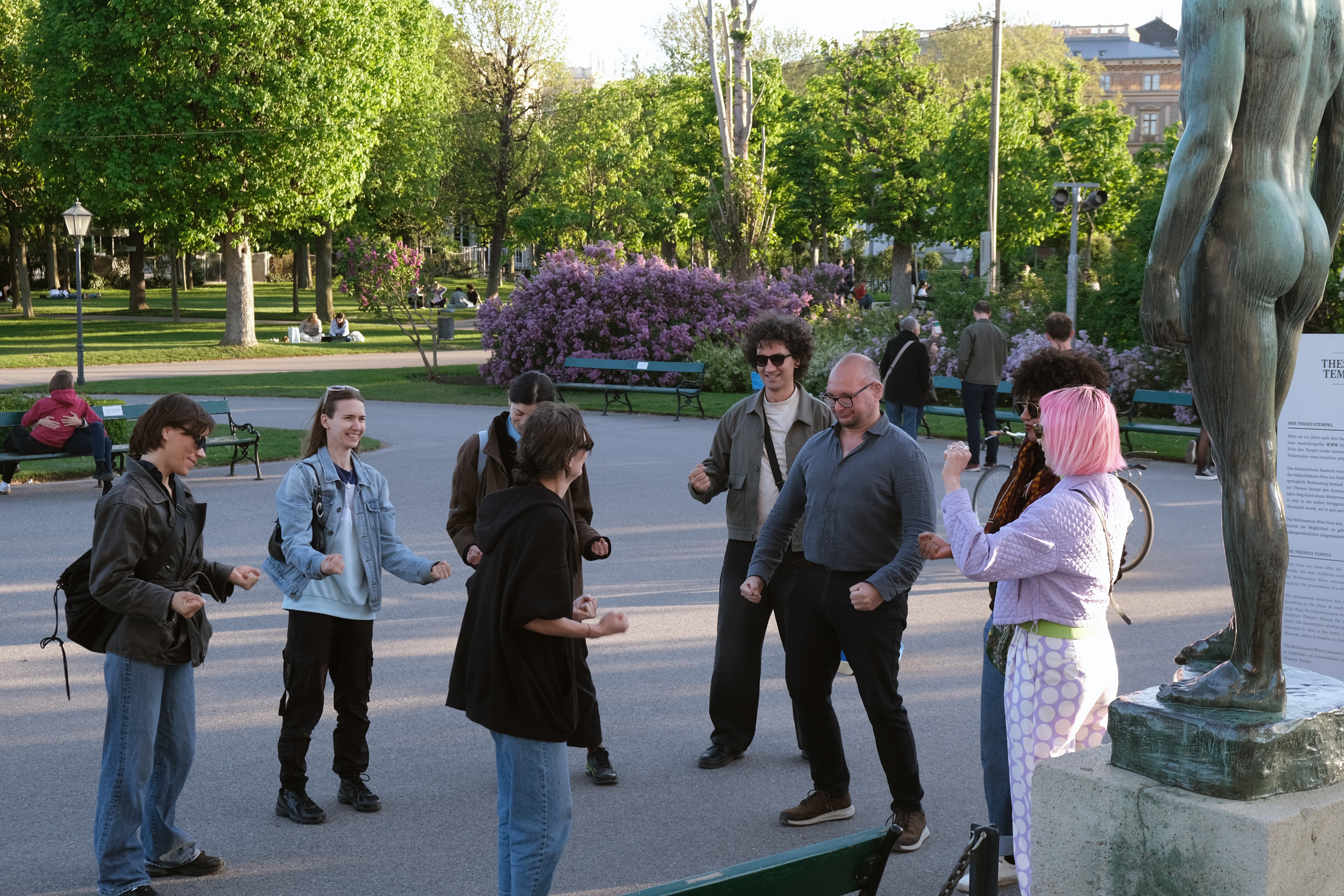
As we are facing the statue of young athlete, I would propose we hold our fists toward it. Not as aggression, but as refusal. A gesture that says no to a regime which, in a historical circle, reappears again. We think of all the nos we want to express through those trembling, sweating, closed palms.
One of the co-walkers, Marei Loellman, mentions that it reminded her of the work of Dr. Peter Levine. In his Somatic Experiencing approach, the freeze response is understood as a last-resort survival mechanism — a state of tonic immobility that animals enter under inescapable threat. Wild animals naturally discharge this stored stress energy by shaking and trembling once the danger has passed. Humans, however, often suppress this instinctive response — through cognitive interference, cultural conditioning, or fear — and the immense energy prepared for survival becomes trapped within the nervous system. If that freeze is never released, it can manifest as exhaustion, panic, or a felt sense of being permanently stuck.
Levine’s therapy works by encouraging small, spontaneous movements — trembling, shaking — to help the body complete the defensive response it never got to finish. The shaking fist we perform in front of the statue in Volksgarten, facing each other, is then not only a political and aesthetic gesture. It is also our somatic agency — and our healing. A body remembering how to discharge what it was not allowed to release.
The third stop at Heldenplatz
Zebras are among the creatures among which you can easily distinguish each individual. The pattern of their stripes is unique and unrepeatable for each one – similar to our fingerprints. However, according to one theory, this very pattern creates a confusing effect in a fleeing herd, making it difficult for predators to catch individual zebras. Individuality is completely dissolved in the optical dizziness of the mass of moving ornament.
Many of us can probably recall that spectacular scene from Lang’s aforementioned film Metropolis, in which two shifts of enslaved workers alternate at the elevator in a very expressionistic choreography. We probably won’t remember any individual, only a mass of indistinguishable parts. And this despite the fact that in that choreographic presentation each of them copes with unbearable fatigue and tries to maintain the rhythm of movement dictated by the machine operation. All the weaknesses and imperfections of the individuals cancel each other out, and only an anonymous mass remains.
A mass of angry protesters or, conversely, fanatically enthusiastic crowds resonate in unison. They do not have to be united by synchronized choreography like a marching army or a dance choir, the same mix of performatives and physical identification with the given place and situation is enough. These are exactly the situations where we can only look for exceptions confirming the rule in old photographs – the lost sheep of the flock, in the style of Where’s Wally? Right here we can recall an event so effectively documented by Nazi propaganda: the triumphant welcome of the Führer after the Anschluss of Austria in 1938.
ZŽ:
Standing here, facing the memory of a historically terrifying choreography of mass, we found ourselves thinking: what is — what was, what could be — an antifascist dance?
San Francisco-based choreographer Keith Hennessy, who came last summer to Telocvičňa — the dance laboratory in Bratislava — thanks to the invitation of Eva Priečková, taught us his practice called Antifa Dance. In it, he plays a fascist song slowed down until it becomes only a drone, and people in couples, standing arm to arm, begin to dance in parallel unison.
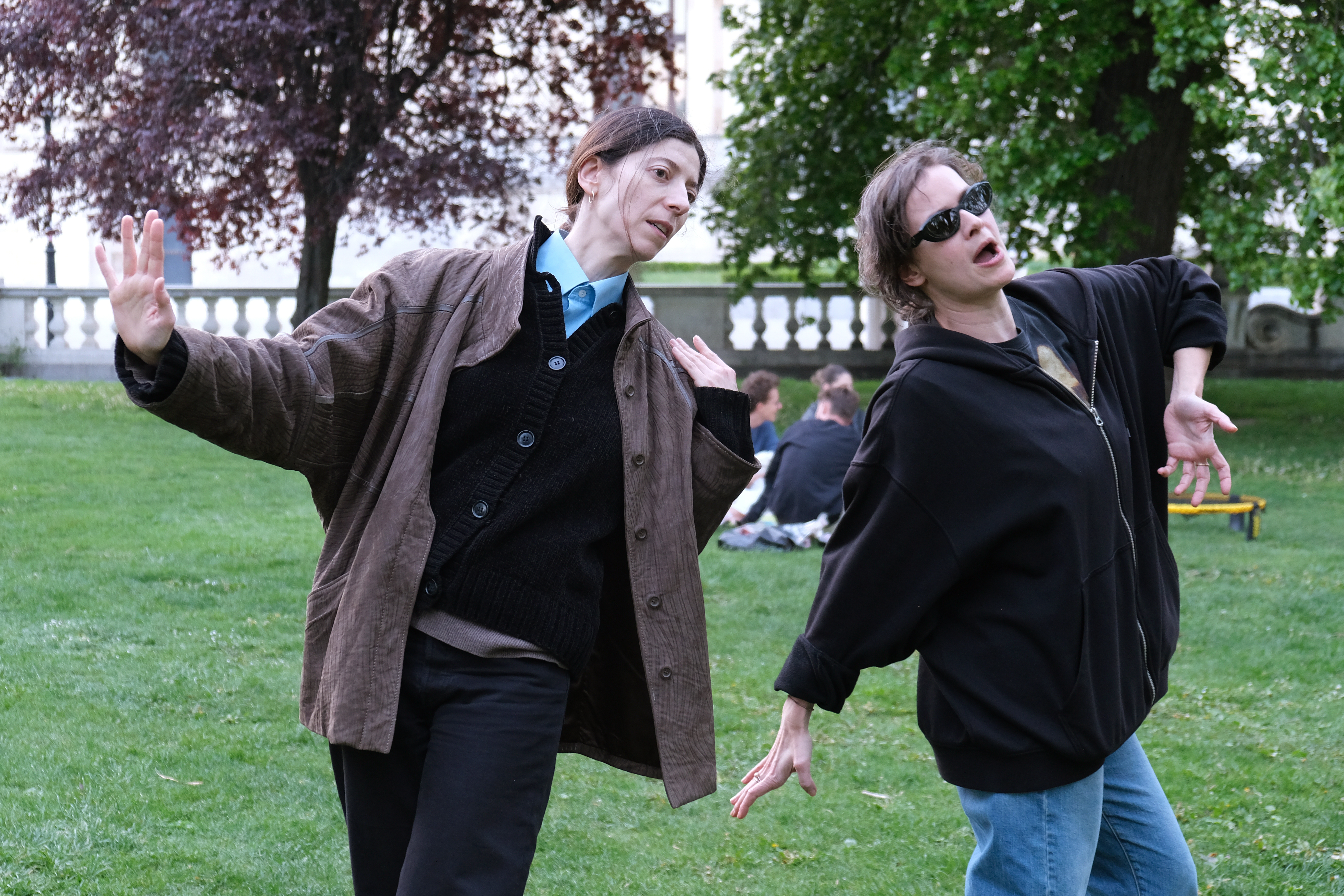
Teaching together with my dear friend Eva Priečková in Bratislava last week, we wanted to continue in the legacy of Keith and ask: what is Antifa Dance for us, in our context? Our version came from thinking about the delay of unison. About introducing symmetry as a situation where we negotiate who leads and who follows. We were drawn to that dance in between — the dance of negotiation. A dance of messy hierarchy, never fully horizontal, never fully vertical. Questioning, and playful.
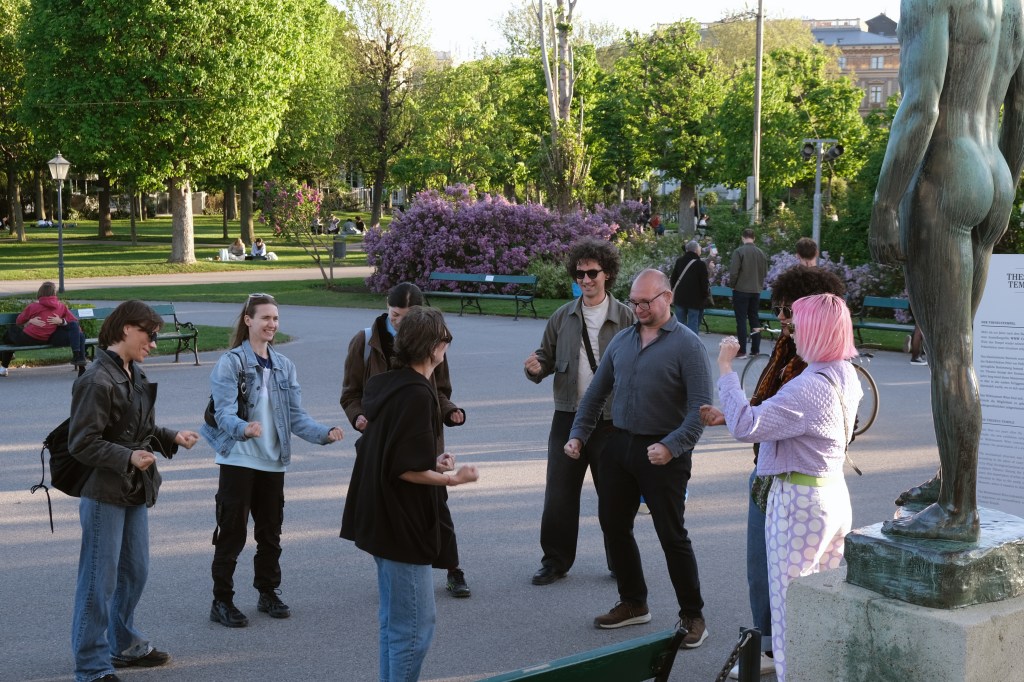
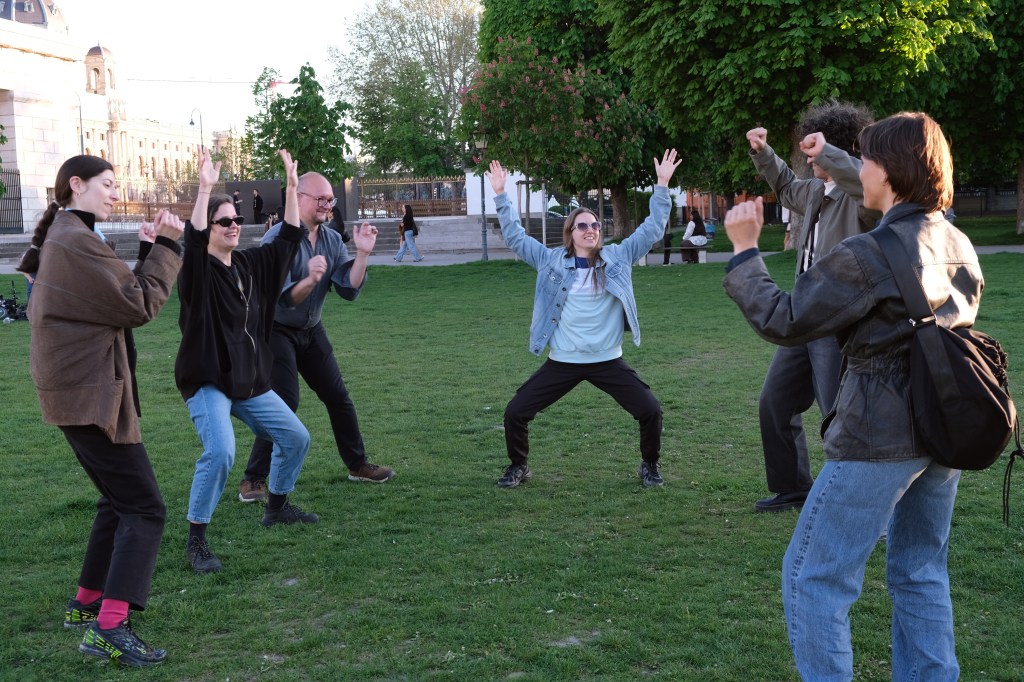
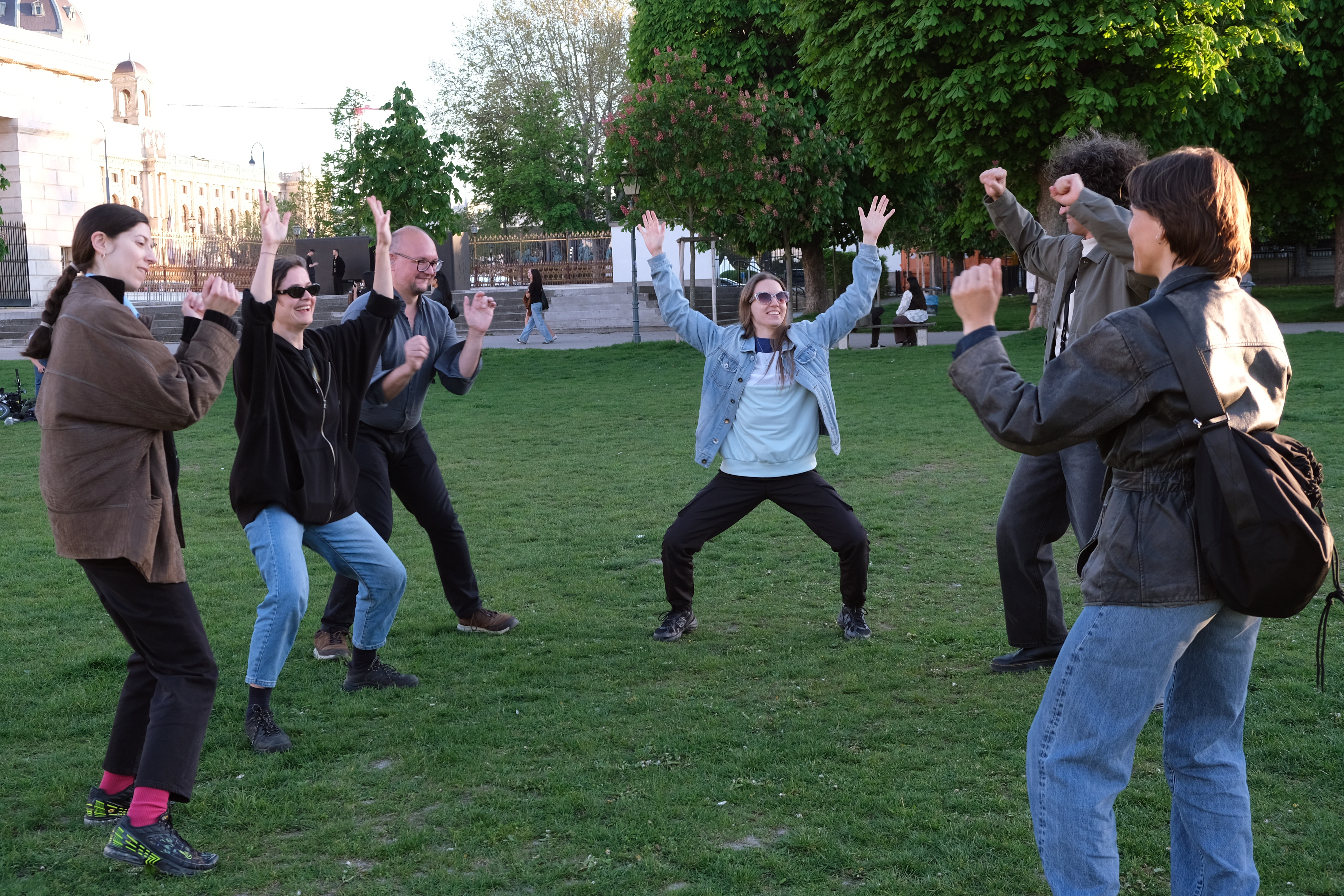
Standing in the fresh green grass in front of that memory, we try this game with our co-walkers. Mirroring and guiding each other’s movement, we form as a group a grotesque negotiation of what the actual movement even was — blurring follower and leader, and asking how it is shaped by delay. What does hierarchy feel like from inside the body?
One of the co-walkers, artist Clara Reiner, offers an important counterpoint: even as we speak of unison choreography in this context as something sinister, unison itself can be deeply pleasurable — and doesn’t have to be immediately fascist. There are many unisons used in non-fascist contexts, helping a group move through a shared trance or feeling of belonging. As dancer Eva Urbanová adds: it is usually a question of intention.
But what about those for whom belonging itself has been weaponised? Those who were never offered the unison — only labelled, excluded, marked as deviant? That question sits at the root of what I started calling antisocial dance.
Asozial — asocial — was the word the Nazis used to mark those who didn’t fit: Roma people, queer people, the mad, the sick, the maladaptive. They called them antisocial. But what if that word is not a flaw, but an emancipation? I’ve been using it a lot lately — not as an insult, but as a break from stimulation. Antisocial, for me, is not about being against being social. It is about being against normative socialisation — the pressure to adapt, optimise, network, perform connection. It is about giving a voice to those who were never offered the unison.
The last stop at the Burgarten
Burggarten is still an oasis of sorts between the busy streets of the inner city and the endless traffic of the Ring. In the interwar period, it also played a significant role as the scene of a number of significant avant-garde dance events of the time. In the summer months, it was a great alternative to the usual enclosed spaces.
So far, we have mainly dealt with bodies alienated from themselves – Bodies that the political, economic and technological pressures of civilization have made incomplete, manipulated and subordinate to higher wholes. However, in this place we can breathe a little sigh of relief, just like the spectators of local performances in the often dramatic interwar period.
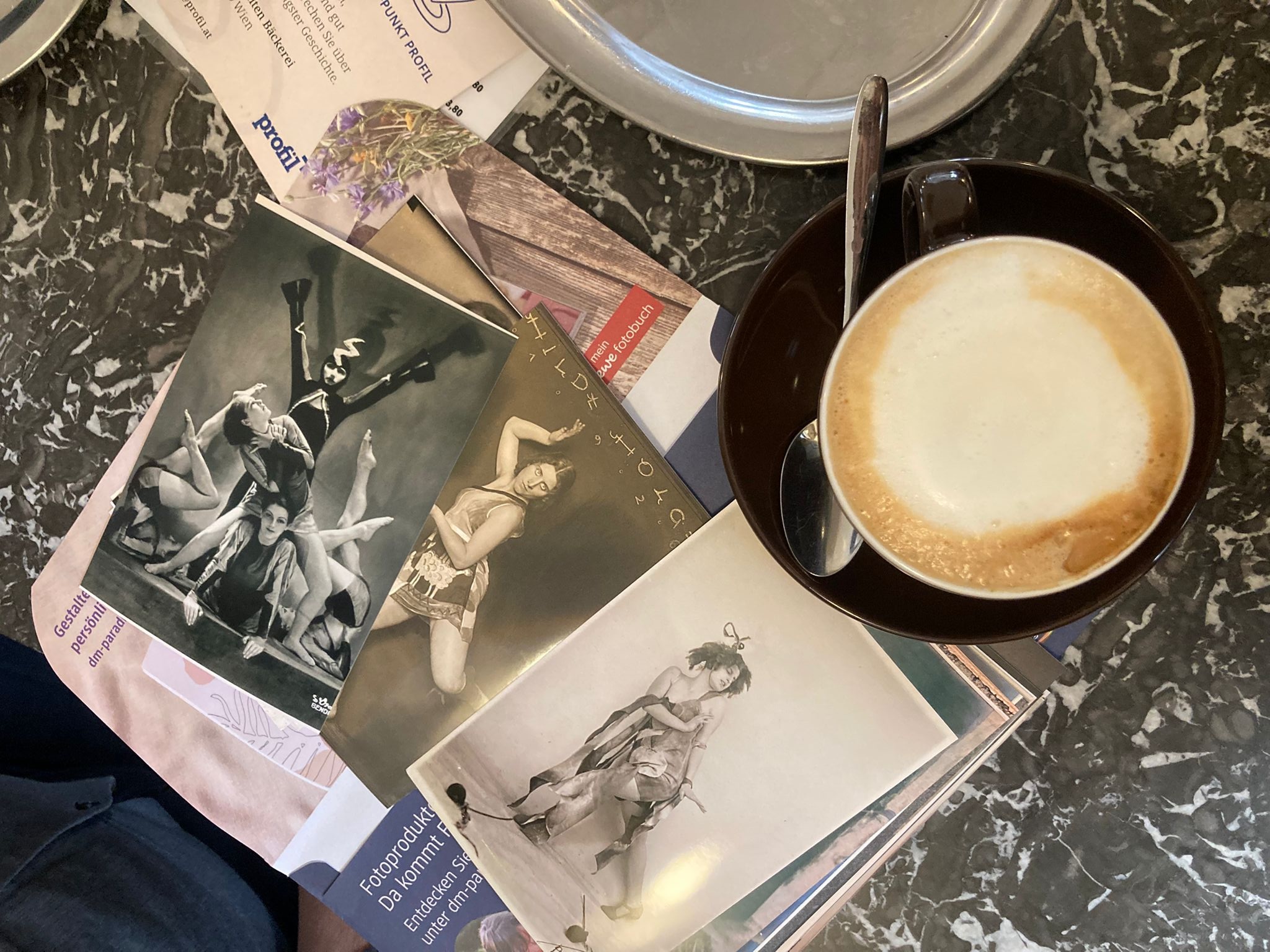
The local dance performances of prominent individualities of modern dance such as the Viennese Gertrud Bodenwieser or Hilde Holger, as well as the Czech Zdeňka Podhajská, became not only an expression of the liberated and emancipated expression of strong female creative personalities, but also revealed the remaining belief – from today’s conventional perspective a bit paradoxical in the cradle of psychoanalysis, that “the body”— conceived as an ideal topos of expression— held the potential to heal the civilizational and social damage wrought by modernization.
Unlike the radical positions of some avant-garde movements – such as Italian Futurism, Soviet Constructivism or Bauhaus – these artists often did not trust the thesis about the positive transformative influence of technology and engineering. We could already see this in Dämon Maschine by Gertrud Bodenwieser. Hilde Holger also reflected a similar idea in her choreography Mechanical Ballet from 1926, understanding the exoskeleton of the costume as a form of prison that limits natural mobility. She is even said to have directly told her students “I do not want you to function as a machine”.
ZŽ:
After Viktor invited me to join this dialogical walk-in-progress, we spent a long time in conversation — him sending me materials, beautiful old photographs of different dancers, newspaper excerpts, critical reviews, and texts written by the dancers themselves or their students. I was moved by his obsession. By the time he spends with those women.
One of the critiques written by Václav Pekárek in Lidové Noviny describes performance of Zdenka Podhajská in a way that is telling in its sexism. He writes of a woman with too much energy that “must be discharged somewhere — so let it be dance,” attributing her work not to artistic vision but to an excess of temperament, masked by what he calls “feverish mimicry, particularly of the face.” A woman too much. A body that needed to be explained away.
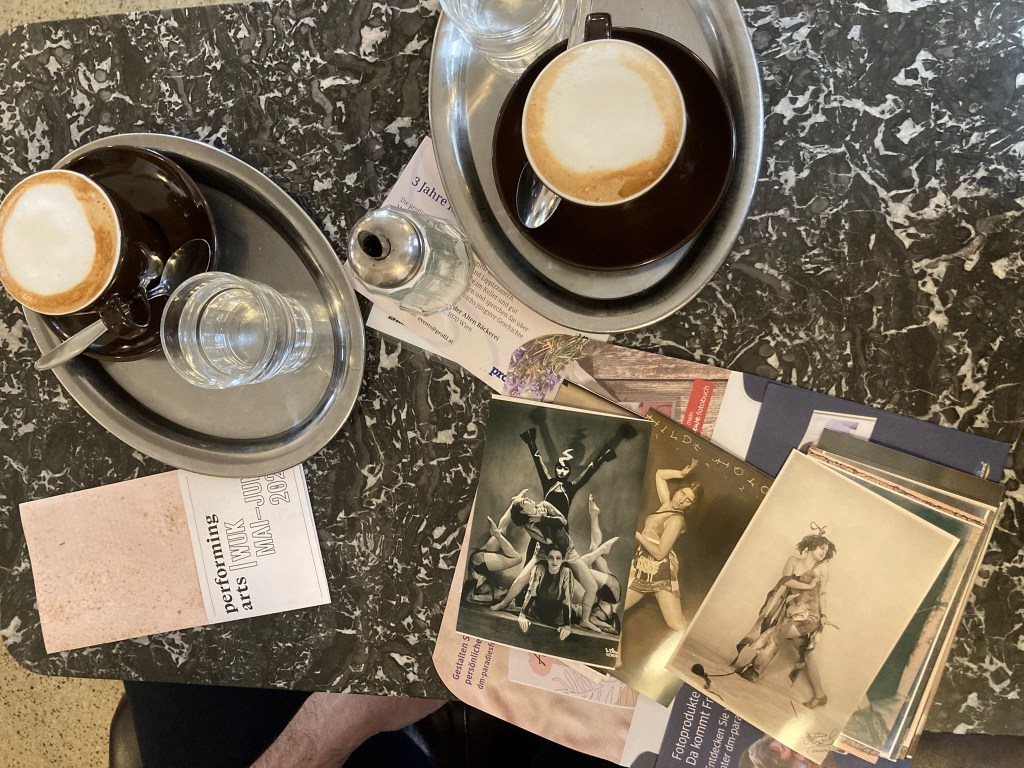
And yet — unlike Hilde Holger and Gertrud Bodenwieser, who left behind rich archives in Vienna with documented works and photographs, we have no videos of Zdenka Podhajská’s work at all. The only archival material that remains are photographs.
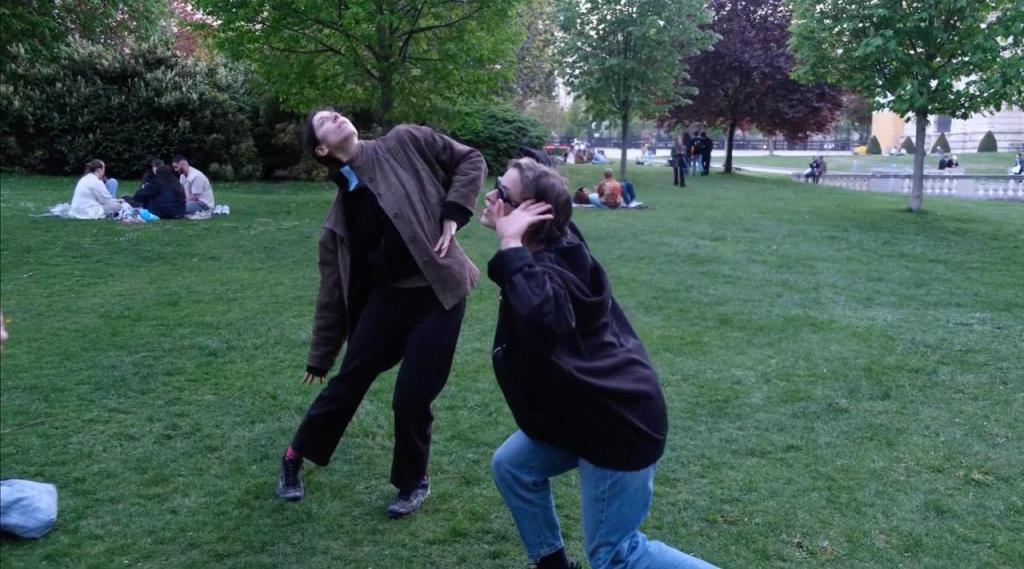
So today, in this garden, we would like to summon Zdenka’s temperament. Through a small diorama game — some of us will hold the photographs that Viktor meticulously gathered from her archive, and others will attempt, based on those images, to re-enact her dance. To let her excess of temperament and feverish mimicry move through us.
________________________
Viktor Čech is Artist-in-Residence in MuseumsQuartier Wien in cooperation with tranzit.org/ Erste Stiftung March/April 2026.
_______________________
Thanks to: MQ Wien, Helena Wikström, Clara Reiner, Eva Urbanová, Marei Loellman and everyone who participated
Photos: Helena Wikström
 ART HAS NO HISTORY
You must be logged in to post a comment.